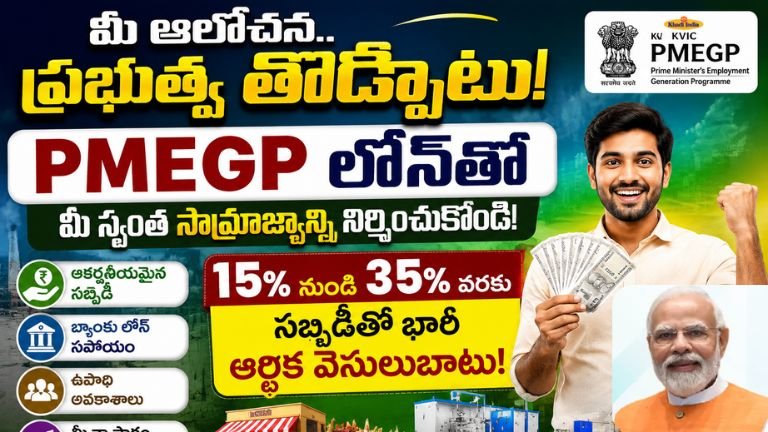
Turn Your Business Idea into Reality: Get Up to 35% Government Subsidy with PMEGP Loans
Have a brilliant business idea but lacking the capital to launch it? You don’t have to put your entrepreneurial dreams on hold. The Government of India’s flagship program—the Prime Minister’s Employment Generation Programme (PMEGP)—is designed specifically to help first-generation entrepreneurs build their own business empires.
By offering credit-linked financial assistance alongside massive subsidies ranging from 15% to 35%, the PMEGP scheme makes setting up a new business highly affordable. Let’s break down how this loan works, who qualifies, and how you can apply.
What is the PMEGP Scheme?
Administered by the Ministry of Micro, Small and Medium Enterprises (MSME), PMEGP is a credit-linked subsidy program implemented nationally by the Khadi and Village Industries Commission (KVIC). Instead of a direct government grant, you secure a bank loan where the government pays a substantial portion of your project cost upfront as “Margin Money” (Subsidy). This significantly reduces your overall loan liability and monthly EMIs.
The PMEGP Subsidy and Funding Structure
Under PMEGP, you only need to contribute a tiny fraction of the project cost out of your own pocket. The government covers a major portion through a subsidy, and commercial banks finance the remaining balance.
Maximum Project Cost Limits
-
Manufacturing Sector: Up to ₹50 Lakh
-
Service / Business Sector: Up to ₹20 Lakh
PMEGP Subsidy Rate Matrix
The exact percentage of your financial subsidy depends on your social category and where you establish your unit:
| Applicant Category | Beneficiary’s Own Contribution | Subsidy Rate (Urban Areas) | Subsidy Rate (Rural Areas) |
| General Category | 10% of project cost | 15% | 25% |
| Special Category (Women, SC, ST, OBC, Minorities, Ex-servicemen, Transgender, Differently-abled, NER, Border/Hill areas) | 5% of project cost | 25% | 35% |
The Rural & Women Advantage: If you are a woman entrepreneur or belong to a special category setting up a micro-enterprise in a rural area, 35% of your total project cost is completely free government money. You only bring 5% to the table, and the bank covers the rest.
Am I Eligible for a PMEGP Loan?
To ensure the funds reach genuine first-generation business owners, KVIC enforces specific baseline eligibility rules:
-
Age: You must be an Indian citizen aged 18 years or above. There is no upper age limit.
-
Minimum Education: If your proposed project costs more than ₹10 Lakh in Manufacturing or more than ₹5 Lakh in the Service sector, you must have passed at least Class 8 (VIII standard). For lower project amounts, no formal education certificate is mandatory.
-
New Businesses Only: The scheme is strictly applicable to newly established micro-enterprises. Existing units seeking ordinary business expansion or modernization do not qualify.
-
No Double Dipping: You must not have availed of any other government subsidy under schemes like PMRY or REGP in the past.
Comprehensive List of Eligible Projects under PMEGP
The PMEGP scheme covers a massive list of business activities across various industries. To give you a clear roadmap, here are some of the most profitable and frequently approved projects categorized by sector:
1. Agro-Based & Food Processing Industries
Food processing is one of the highest-priority sectors under PMEGP due to its immense employment potential.
-
Flour Mills & Power Atta Chakkis
-
Spice Grinding and Packing Units (Masala Udyog)
-
Rice Milling and Pulse Processing Units
-
Bakery Products, Biscuits, and Confectionery Making
-
Fruit and Vegetable Processing (Pickles, Jams, Juices, and Canning)
-
Dairy Products Manufacturing (Khava, Paneer, and Ghee processing)
-
Banana/Potato Chips and Noodle Making Units
2. Forest-Based & Handmade Paper Industries
Eco-friendly manufacturing projects receive strong backing and high approval rates.
-
Handmade Paper Bags and Envelopes Production
-
Exercise Notebook Binding and Stationary Item Manufacturing
-
Paper Cups, Paper Plates, and Disposable Containers
-
Bamboo and Cane Furniture/Handicraft Units
-
Agarbatti (Incense Stick) Manufacturing and Packing
-
Herbal/Ayurvedic Medicine Collection and Processing
3. Textile and Readymade Garment Sector
This sector accounts for a major portion of successful women-led enterprises funded under PMEGP.
-
Readymade Garment Manufacturing (Tailoring & Boutique setups)
-
Handloom Cloth Weaving and Power Loom Units
-
Computerized Embroidery and Zig-Zag Zari Works
-
Cotton Bed Sheets, Pillows, and Mattress Production
-
Jute Bag and Non-Woven Eco-Friendly Bag Stitching
4. Mineral, Chemical, and Polymer-Based Industries
Capital-intensive micro-manufacturing setups that utilize raw minerals or chemical formulations.
-
Fly Ash Bricks and Hollow Concrete Blocks Manufacturing
-
Detergent Powder and Liquid Soap Production
-
Plastic Injection Moulding and Pet Bottle Manufacturing
-
PVC Shoes and Hawai Chappal (Footwear) Units
-
Mineral Water Plant Setup
-
Biomass Briquettes/Bio-fuel Units
5. Engineering, Electronics, and Service Sector Units
If you want to start a professional service agency or technical workshop, these fall perfectly under the ₹20 Lakh service cap.
-
Automobile Service Stations and Garage Setups
-
Digital Service Hubs, Cyber Cafés, and DTP/Graphic Design Centers
-
Beauty Parlours, Salons, and Wellness Gym Centers
-
Electrical Motor Rewinding and Transformer Servicing Shop
-
Diagnostic Labs, Dental Clinics, and Physiotherapy Centers
-
Event Management, Tent House, Sound System, and Shamyana Supply Agencies
The PMEGP Negative List (Banned Businesses)
While hundreds of businesses are supported, some are strictly prohibited under the PMEGP scheme guidelines. Make sure your business idea does not involve:
Any business linked to the processing, canning, or serving of Meat or Slaughterhouse activities.
Manufacturing or sale of intoxicants, alcohol, or tobacco products (like Beedis, Pan Shop, Cigarettes, Dhaba/Hotel serving liquor).
Pure crop cultivation, plantations (Tea, Coffee, Rubber), or primary animal husbandry (though downstream value-addition like milk processing or commercial fruit juice factories are fully allowed).
Manufacturing of polythene bags less than the legally prescribed micron thickness.
Financial Architecture: How Your Loan Components Work
Understanding the money flow is vital before filing your sheet. A PMEGP loan is essentially a composite financial structure split into three components: Own Contribution, Margin Money (Subsidy), and Bank Term Loan / Working Capital.
Let’s assume you belong to a Special Category (e.g., Woman Entrepreneur) and plan to launch a Rural Manufacturing Unit worth ₹10,00,000 (10 Lakh). Here is exactly how your project finance breaks down:
How the Subsidy Reimbursement Operates:
-
You apply and get sanctioned for the full loan amount minus your own contribution ($₹9,50,000$).
-
The bank releases the funds so you can buy machinery and start your production.
-
The government deposits your ₹3,50,000 subsidy directly into your loan-linked account.
-
The bank keeps this subsidy locked in a zero-interest Term Deposit Receipt (TDR) for a mandatory 3-year period.
-
You pay EMIs calculated on the loan balance. After 3 successful operational years, the bank applies the ₹3.5 Lakh TDR directly against your principal balance, permanently wiping out that portion of your debt!
Detailed Step-by-Step Guide: How to Apply Online
Applications can only be submitted online through the centralized server. Follow these clear steps to avoid form rejection:
Phase 1: Account Creation and Verification
-
Open your web browser and navigate to the official portal: www.kviconline.gov.in/pmegpeportal.
-
Click on the button “Application Form for New Unit” under the individual tracking section.
-
Enter your 12-digit Aadhaar Card Number and click to verify. The system will send an OTP to your Aadhaar-linked mobile phone.
-
Input your legal name matching your government identity documents precisely to initialize your profile ledger.
Phase 2: Selecting Your Implementing Agency
This is where many applicants make critical mistakes. You must choose one of the following local nodal agencies based on where your unit is located:
-
KVIC (Khadi and Village Industries Commission): Select if your unit is anywhere in India (prefers rural but handles urban).
-
KVIB (Khadi and Village Industries Board): State-level boards that handle rural micro-enterprises.
-
DIC (District Industries Centre): Ideal for urban areas or general manufacturing hubs. The local DIC office is often the most accessible for local coordination.
-
Coir Board: Select exclusively if your business involves coconut coir processing products.
Phase 3: Filling the Business Coordinates & Form Checklist
-
Select your target financing bank branch where you maintain a clean track record.
-
Enter your precise structural academic credentials.
-
Fill out your factory’s target address, clearly marking whether it falls under Urban or Rural boundaries based on local Gram Panchayat or Municipal demarcations. (Remember: rural location increases your subsidy cap by an extra 10%).
-
Input your calculated employee metrics—state how many direct or indirect jobs your plant will create once fully functional.
Phase 4: Document Upload Requirements
Upload clean, scanned copies of your structural document package. Keep these files ready in PDF or JPEG format (size less than 1 MB):
-
Passport-Sized Photograph: Recent colored photo.
-
Aadhaar Card & PAN Card: Front and back copies.
-
Highest Educational / Skill Training Certificate: Marksheets verifying at least Class 8 pass for projects over 5/10 Lakh.
-
Caste / Special Category Certificate: Crucial if you are claiming the higher 25% or 35% subsidy rate.
-
Rural Area Certificate: Signed by the local Sarpanch or Gram Panchayat secretary to formally validate rural location.
-
Detailed Project Report (DPR): The actual business blueprint outlining costs, assets, and operational projections.
How to Build a Winning Detailed Project Report (DPR)
The Detailed Project Report (DPR) is the most critical component of your application package. It acts as your primary financial pitch to both the government scrutiny committee and the bank loan officer. A weak, poorly calculated project report is the number one reason PMEGP applications get rejected.
A professional DPR must contain the following structural sections:
-
Introduction and Market Scope: A clear brief detailing what your business does, who your target buyers are, and why there is a demand gap for your product in the local region.
-
Fixed Capital Expenditures: Itemized costs of land lease, building construction/renovation, and a comprehensive list of required plant machinery with official supplier price quotations.
-
Working Capital Cycle: Estimated costs for running operations for one production cycle, including raw material sourcing, factory electricity bills, and employee wages.
-
Financial Projections Sheet: A projected Balance Sheet and Profit & Loss statement covering the next 3 to 5 years, showing estimated sales revenues, depreciation charts, and break-even analysis metrics.
Comparison: PMEGP Loan vs. MUDRA Loan
Many budding entrepreneurs get confused between PMEGP and Pradhan Mantri MUDRA Yojana (PMMY). While both provide financing for small businesses, they are structurally different:
| Feature | PMEGP Loan Scheme | MUDRA Loan Scheme |
| Primary Target | Strictly New Micro-Enterprises | Existing and New Small Businesses |
| Maximum Funding | Up to ₹50 Lakh (Mfg) / ₹20 Lakh (Service) | Up to ₹10 Lakh (Shishu, Kishore, Tarun categories) |
| Government Subsidy | Yes, massive 15% to 35% margin money support | No subsidy provided on the principal component |
| Mandatory Training | Requires 5 to 10 days EDP training post-sanction | No mandatory pre-requisite business training |
| Lending Focus | Manufacturing and organized service units | Small retail shops, traders, and commercial transport |
Post-Submission Timeline: What Happens Next?
Once you hit the submit button on the KVIC portal, your application goes through a structured, multi-step review process:
-
Agency Scrutiny (15-30 Days): The chosen agency (KVIC/DIC) reviews your digital documents. If any discrepancies are found, they will mark it as “Deficient” and ask you to re-upload documents. If everything is clear, they forward it to your chosen bank.
-
Bank Verification & Sanction (30-45 Days): The bank field officer may visit your proposed business site to inspect feasibility. Based on your credit history (CIBIL score) and project viability, the bank issues an official Loan Sanction Letter.
-
EDP Training Completion (10 Days): Once sanctioned, you must complete your Entrepreneurship Development Programme (EDP) training via the online portal. The certificate generated must be submitted to the bank.
-
Loan Disbursal & Subsidy Claim: The bank registers your account on the portal, releases the initial capital installment, and files an online claim to KVIC to secure your margin money subsidy.
Quick Resources & Official Portals
Don’t let a lack of initial capital limit your potential. Get real-time application updates, track your forms, or join business mastermind groups using these verified channels:
| Resource | Direct Web Link |
| Official Application Portal | Apply on KVIC Portal |
| Ministry of MSME Portal | Check MSME Scheme Details |
| Telegram Channel | Join Telegram Business Community |
| WhatsApp Channel | Follow Job & Loan Updates on WhatsApp |
Take control of your professional financial future today, utilize the immense financial relief of government subsidies, and start building your own business empire under PMEGP!