Empowering Women: Free Tailoring Training and Sewing Machine Schemes in Andhra Pradesh
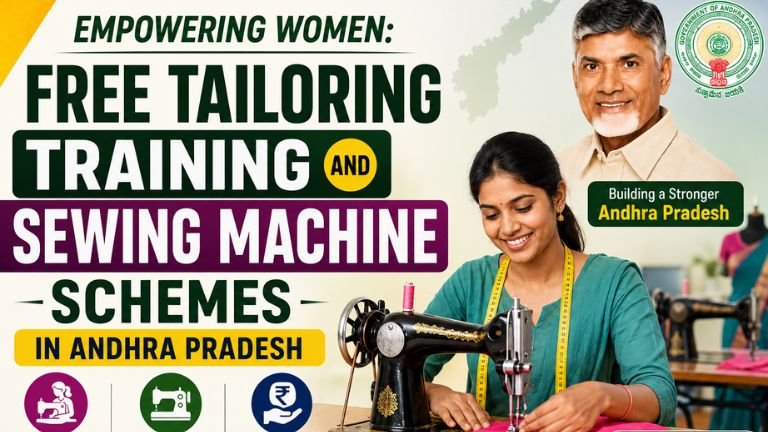
Economic self-reliance forms the cornerstone of sustainable women empowerment. To convert this vision into a scalable reality, the Government of Andhra Pradesh has implemented an extensive vocational framework. Focused heavily on rural, semi-urban, and economically marginalized areas, the state-backed Free Tailoring Training and Sewing Machine Distribution Scheme serves as a vital economic launcher for women seeking financial independence.
This initiative transitions women from domestic stitching roles into specialized boutique owners and micro-entrepreneurs.
Scope and Scale of the Andhra Pradesh Initiative
The government has committed Rs. 255 crore toward a multi-phase structural rollout aimed at empowering over one lakh women across the state’s 175 Assembly constituencies. The deployment architecture partitions support across specialized social welfare corporations to target underrepresented demographics precisely:
-
Target Population: A total of 1,02,832 women are systematically selected across all districts for intensive skill development.
-
Corporation Allocation Matrix:
-
Backward Classes (BC) Welfare Corporation: 46,044 beneficiaries.
-
Economically Weaker Sections (EWS) Category: 45,772 beneficiaries.
-
Kapu Welfare Development Corporation: 11,016 beneficiaries (encompassing Kapu, Balija, Telaga, and Ontari sub-castes).
-
-
End-to-End Asset Handover: Unlike traditional training-only modules, every woman who successfully satisfies the training duration and passes the final validation module receives a high-quality sewing machine completely free of cost to initiate her home-based enterprise immediately.
Training Structure and Industrial Curriculum
The program moves beyond basic stitching mechanics, delivering a standardized, comprehensive 45-to-90-day structural curriculum totaling up to 360 hours of expert-led instruction.
Technical Skill Blocks
-
Pattern Engineering: Master cutting mechanics, precise spatial calculations, drafting based on advanced size charts, and optimal fabric utilization to minimize raw material waste.
-
Contemporary Garment Design: Specialized training modules focused on high-demand market trends, including modern blouses, design lining, Chudidars, long frocks, and intricate embroidery work.
-
Machine Maintenance: Training on the mechanical operation of semi-automatic and automatic units, troubleshooting basic hardware errors, tension tuning, and oiling protocols.
Operational Framework
-
Biometric Tracking: To preserve institutional transparency, centers enforce mobile-linked digital attendance tracking. Trainees must meet a minimum attendance threshold to remain eligible for the asset distribution phase.
-
Full Financial Coverage: The state covers all operational overheads (amounting to an investment value of roughly Rs. 25,000 per selected candidate), ensuring zero training fees, free material toolkits, and accessible local training centers at the constituency level.
Mandatory Eligibility Criteria
To preserve the scheme’s focus on genuine economic upliftment, candidate selection requires strict adherence to these administrative parameters:
-
Residency: The applicant must be a permanent resident of Andhra Pradesh.
-
Age Bracket: Typically restricted to adult women, generally matching the working-age window between 21 and 60 years of age.
-
Economic Status: Applicants must belong to the Below Poverty Line (BPL) segment, verified primarily through a valid White Ration Card or a Meeseva-issued Income Certificate.
-
Community Validation: Candidates applying under specific corporate quotas (BC, EWS, or Kapu sub-castes) must possess an authenticated Caste Certificate.
Step-by-Step Application Guide for Free Tailoring and Sewing Machine Schemes
Securing enrollment requires navigating the state’s digital platforms correctly to link personal credentials directly with welfare department databases.
Selection and Verification Protocol
Once the digital application window closes, data sets pass through a multi-tier verification process:
Verification Directive: Field validation is managed through the Grama/Ward Sachivalayam system under the direct administrative supervision of the respective District Collectors and Managing Directors of the corporate boards. Selected applicants will receive an official SMS notification containing directions to present their original physical certificates at designated constituency verification centers prior to the commencement of the training batches.