Comprehensive Guide to AP Mission Vatsalya Scheme 2026: Financial Assistance of ₹4,000/Month for Eligible Children
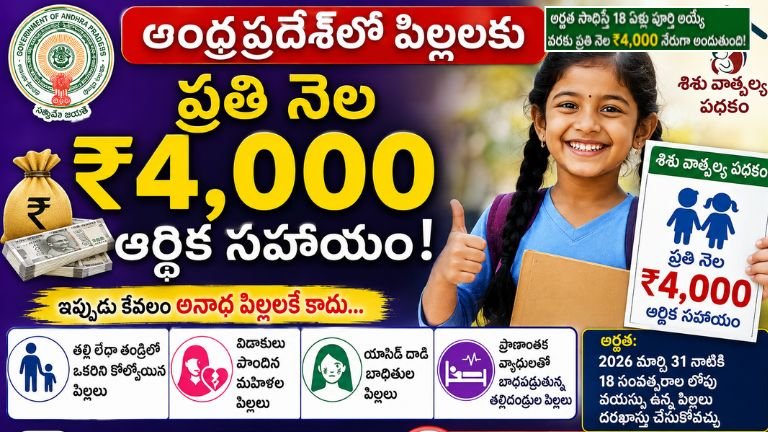
The Government of Andhra Pradesh has taken a monumental step toward strengthening child protection and welfare across the state. Under the Mission Vatsalya Scheme (often locally referred to as Shishu Vatsalya), the state government provides robust financial sponsorship of ₹4,000 per month to vulnerable, orphaned, and distressed children.
Far from being a basic handout, this financial backbone is legally anchored under the Juvenile Justice (Care and Protection of Children) Act and is aimed squarely at preventing child labor, preventing school dropouts, and ensuring that children without standard familial safety nets do not lose their right to a safe childhood and quality education.
Crucially, the eligibility net has been significantly widened. The financial assistance is no longer restricted strictly to absolute orphans; it covers an exhaustive matrix of children facing multi-layered social and economic hardships.
Comprehensive Eligibility Criteria: Who Qualifies?
To qualify for the monthly payment of ₹4,000, the applicant child must be a permanent resident of Andhra Pradesh and must be under 18 years of age as of the relevant assessment cycle. The scheme divides eligible children into distinct vulnerability brackets:
1. Orphaned and Parental-Loss Brackets
-
Absolute Orphans: Children who have unfortunately lost both of their biological parents and are currently living under the guardianship of extended family members, relatives, or community protectors.
-
Semi-Orphans: Children who have lost one primary breadwinning parent (either the mother or the father), leaving the surviving single parent financially incapable of sustaining basic nutritional and educational costs.
-
Children of Divorced/Abandoned Women: Children belonging to women who are legally divorced, undergoing prolonged legal separation, or have been completely abandoned by their spouses.
2. Extreme Medical & Crisis Circumstances
-
Parents with Critical/Life-Threatening Illnesses: Children whose biological parents are suffering from terminal, advanced-stage, or incapacitating medical conditions (such as advanced cancer, severe renal failure, or advanced HIV/AIDS) that physically and financially prevent them from working or earning a livelihood.
-
Children of Acid Attack Victims: Children whose primary parents or maternal guardians have survived devastating acid attacks and face severe physical, psycho-social, and employment barriers.
3. Children in Need of Care and Protection (CNCP)
Aligned closely with the legal frameworks of Child Welfare Committees (CWCs), the scheme actively covers children rescued from highly compromised structural backgrounds:
-
Formally rescued child laborers or victims of forced brick-kiln/agricultural work.
-
Children rescued from targeted child marriage attempts or cross-border child trafficking networks.
-
Homeless children, street children, runaway youth, and child beggars.
-
Children severely impacted or physically displaced by devastating natural calamities.
Income Limits & Operational Rules
Because Mission Vatsalya is a highly targeted welfare policy designed specifically to reach the absolute bottom of the socio-economic pyramid, it operates under rigid household income limits and structural guidelines:
| Residential Category | Maximum Allowable Family Income |
| Rural Areas (Villages/Mandals) | ₹72,000 maximum annual household income |
| Urban Areas (Municipalities/Corporations) | ₹96,000 maximum annual household income |
Strict Disqualification Rules:
-
The Residential School Rule: If an eligible child is admitted into any government-run residential school (such as APSWREIS, APRJC, Kasturba Gandhi Balika Vidyalayas), or any social welfare hostel where the government already fully bears the structural costs of boarding, lodging, and books, the monthly ₹4,000 sponsorship will not be granted or will be instantly suspended. The scheme is exclusively designed to support children living within a family structure or local community setup.
-
The School Attendance Rule: The child must maintain consistent, verifiable attendance at a registered school. If a beneficiary child drops out of school or misses classes continuously for more than 30 days without a valid medical reason, the disbursement is frozen.
-
The Remarriage Clause: If a child’s mother passes away and the father remarries, or vice-versa, and the new step-parent is financially stable and capable, the local verification committee reviews the case. If a stable dual-parent household is established, the sponsorship may be redirected or discontinued based on the field report.
Mandatory Documentation Checklist
To prevent processing loops, data mismatch rejections, or delays at the verification stage, you must compile complete, clean photocopies alongside original documents for local spot-checking.
-
Identity & Age Proofs: Clear Aadhaar Cards of the child, the biological parents (if surviving), or the active legal guardian. A valid Government Birth Certificate to confirm the child is strictly below 18 years of age.
-
Parental Status Verification Docs:
-
For Orphans/Semi-Orphans: Official Death Certificates issued by the Municipal or Panchayat Registrar indicating the names of the deceased parents.
-
For Divorced/Separated Households: Legal divorce decrees from a family court, or formal separation agreements validated by village elders/local administrative authorities.
-
-
Economic & Social Certification: A freshly issued Income Certificate from the competent revenue authority (MRO/Tahsildar) proving adherence to the rural/urban limits. A valid Caste Certificate and the family’s Rice Card (Ration Card).
-
Educational Proof: An official, active Study Certificate issued by the Headmaster or Principal of the school where the child is currently enrolled for the ongoing academic year.
-
Financial Routing Information: A dedicated bank passbook copy. The account should preferably be a joint bank account held between the minor child and the surviving parent or legal guardian. The front page must clearly display the IFSC code, account number, and clear branch details to facilitate smooth Direct Benefit Transfer (DBT) processing.
-
Visual Documentation: Recent passport-sized photographs of the child alongside the guardian.
Step-by-Step Application Process
The application mechanism combines structural village-level outreach with formal district-level departmental approvals. Here is the step-by-step route to successfully securing enrollment:
Apply Link
The Review and Accountability Framework
To ensure that the financial resources strictly benefit the child’s direct upbringing, nutrition, and mental development, the state exercises systematic annual supervision:
🛡️ The Annual Sponsorship Committee Review: The institutional district committee holds a mandatory review meeting once every calendar year for every sanctioned child. They evaluate whether the child continues to live in a safe family environment, review updated school transcripts, and check health conditions. If a child’s family relocates permanently out of the state or experiences a dramatic positive shift in economic fortune, the monthly sponsorship is ethically reallocated to other children in waiting lists.
By strictly abiding by these structural requirements and submitting clean, legally compliant paperwork, guardians can ensure that vulnerable children receive their rightful financial support, safeguarding their growth and future opportunities up to adulthood.