Complete Guide to Government Free Sewing Machine & Tailoring Schemes in Telangana (2026)
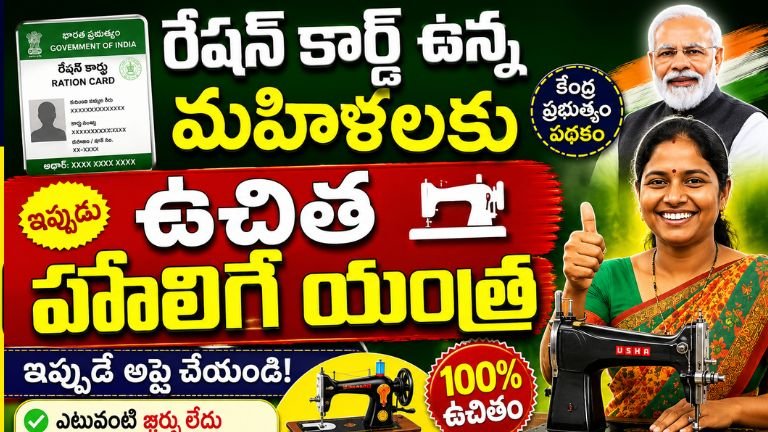
Economic self-reliance is the true cornerstone of women’s empowerment. Recognizing this, both the Central Government of India and the State Government of Telangana have implemented robust, zero-cost welfare schemes tailored for women. These initiatives provide more than just equipment; they offer structured skill incubation, technical certifications, operational toolkits, and direct financial cushions designed to transition women from homemakers to successful, self-employed boutique owners and apparel entrepreneurs.
If you are a resident of Telangana looking to establish a sustainable home-based tailoring micro-enterprise, this detailed operational guide unpacks every active scheme, structural budget allocation, eligibility constraint, and step-by-step application pipeline available to you in 2026.
Comprehensive Overview of Active Free Tailoring & Sewing Machine Schemes
Rather than a single, isolated initiative, multiple departmental programs run in parallel to maximize outreach across diverse social and economic demographics.
1. PM Vishwakarma Yojana (Central Sector Flagship Scheme)
Administered jointly by the Ministry of Micro, Small, and Medium Enterprises (MoMSME) and the Ministry of Skill Development and Entrepreneurship (MSDE), the PM Vishwakarma Scheme treats tailoring (Darzi) as a vital traditional craft. This scheme provides an end-to-end business ecosystem to modernize artisanal setups.
-
₹15,000 E-Voucher Toolkit Grant: Once registered and verified, you do not receive a physical, low-grade sewing machine. Instead, the government credits a Digital E-Voucher worth up to ₹15,000 directly to your registered dashboard profile. This voucher can be redeemed at certified vendor networks specifically for a heavy-duty motorized sewing machine and structural tailoring accessories.
-
Fully Funded Skill Upgradation: Beneficiaries undergo an intensive 5 to 15 days institutional training program to learn modern garment design, pattern stitching, and boutique management.
-
Daily ₹500 Training Stipend: To counteract potential wage loss while attending these modules, the government deposits a cash stipend of ₹500 per day directly via Direct Benefit Transfer (DBT) into your linked bank account.
-
Follow-up Credit Support: Graduated artisans become eligible for collateral-free business expansion loans up to ₹3 Lakhs split into two tranches (₹1 Lakh initial and ₹2 Lakh subsequent) at a highly subsidized 5% concessional interest rate.
2. BC Women Empowerment Scheme (Telangana State Initiative)
Operated directly under the Backward Classes Welfare Department of the Telangana State Government, this scheme targets structural poverty reduction within historically marginalized communities.
-
100% Fully Subsidized Allocation: This program distributes professional-grade composite sewing machines to women belonging to Backward Classes (BC) without requiring out-of-pocket margin money, co-payments, or underlying bank linkages.
-
Constituency-Targeted Mapping: To ensure equitable regional distribution, allocations are dynamically calculated and assigned across every Assembly Constituency in Telangana, managed closely by the respective District Welfare Officers (DWOs).
3. Indiramma Mahila Shakti Program (State Community Framework)
The Indiramma Mahila Shakti initiative uses the widespread network of rural and urban Self-Help Groups (SHGs) under the Society for Elimination of Rural Poverty (SERP) to drive community-level apparel businesses.
-
Cluster-Based Tailoring Hubs: Under this program, the state sets up dedicated apparel training facilities within village clusters.
-
Institutional Orders: Beyond individual machine distribution, SHG members who pick up advanced tailoring skills are directly linked with institutional apparel supply chains—such as manufacturing government school uniforms, medical linens, and state enterprise merchandise—guaranteeing immediate operational cash flows.
Unified Eligibility Framework & Structural Exclusions
To maintain high transparency and avoid duplicate optimization of state welfare funds, specific administrative filters are applied during database cross-referencing.
-
Age Profile: The applicant must be a citizen of India and a resident of Telangana, aged 18 years or older on the exact date of submission. For specific state welfare lines, the upper cap is set to 37 years.
-
Socio-Economic Threshold: For state-centric 100% subsidized programs, holding a valid White Ration Card (Food Security Card) or an active BPL (Below Poverty Line) certification is non-negotiable.
-
The Single-Beneficiary Household Filter: For the central PM Vishwakarma framework, structural distribution is legally limited to only one member per family unit (defined strictly as husband, wife, and dependent unmarried children).
-
Anti-Overlap Rule: Applicants must not have availed themselves of an equivalent tool-kit subsidy or self-employment credit line (such as PMEGP, PM SVANidhi, or Mudra loans) from any central or state department within the preceding 5 years.
Mandatory Documentation & Authentication Matrix
To ensure swift verification across digital portals, compile this standardized set of documents. Ensure all certificates contain matching spelling structures across records.
| Document Name | Mandatory Verification Role | Administrative Issuing Authority |
| Aadhaar Card | Core biometric authentication and identity lock | Unique Identification Authority of India (UIDAI) |
| White Ration Card (FSC) | Definitive proof of household low-income/BPL standing | Department of Consumer Affairs, Civil Supplies (Telangana) |
| Caste Certificate | Validates BC category requirements for state subsidies | Revenue Department (Mandal Revenue Officer / Tahsildar) |
| Residence / Domicile Certificate | Confirms local state tenancy status | Local Revenue Authority via MeeSeva |
| Bank Passbook Copy | Essential for DBT routing of daily training stipends | Any Scheduled Commercial Bank (Must be Aadhaar-Seeded) |
| Passport Size Photographs | Physical attachment to offline registers and applications | Recent, high-resolution prints with neutral backgrounds |
Step-by-Step Application Routing & Pipeline Execution
Because the administration is divided across different digital systems, candidates must execute their application via the exact procedural channels detailed below:
Post-Submission Verification & Tracking Infrastructure
Once your application is logged into the state or central data repository, it undergoes a rigid, automated Three-Tier Verification Process before the financial grants or toolkits are cleared for release:
[Stage 1: Local Screening]     ➔ Verified by Gram Panchayat Secretary (Rural) or Urban Local Body (Urban)
[Stage 2: District Evaluation] ➔ Vetted by the District Implementation Committee (DIC)
[Stage 3: State/Central Apex]  ➔ Final Approval by the Screening Committee & Batch Allotment
Checking Your Application Status Online
You can monitor your application state dynamically using the central tracking platform:
-
Navigate to the official portal:
pmvishwakarma.gov.in. -
Locate the Applicant/Beneficiary Login tab on the main navigation panel.
-
Enter your registered mobile number and clear the real-time Captcha puzzle.
-
Input the secure one-time password (OTP) sent to your mobile device.
-
Your personal tracking dashboard will render immediately, displaying whether your file is currently pending at the local, district, or final committee phase.
If your dashboard status displays a “Rejected” marker, immediately click the error log to view the mismatch details. Rejections typically occur if a family member has already registered under the same ration card, if your Aadhaar details do not match your banking records, or if an invalid trade code was input during the data-entry process at the CSC. For direct ground-level issues, beneficiaries can reach the dedicated central resolution help-desk at 1800-569-1565 or visit the nearest district MSME Development and Facilitation Office (MSME-DFO).
Strategic Action Checklist for Aspiring Micro-Entrepreneurs
To maximize your chances of approval and fast-track your enrollment into the upcoming training batches, keep these critical items checked off:
-
Aadhaar-Mobile Sync: Confirm your mobile number is updated and operational at the permanent Aadhaar center. If your phone cannot receive text-based OTPs, digital portal submissions will fail automatically during the login phase.
-
Bank Account Seeding: Ensure your bank account status is fully set to “Active” and explicitly linked with Aadhaar-based payment structures (NPCI mapping). This guarantees that your training stipends drop into your account without processing delays.
-
Avoid Sub-Contractors: Government schemes do not authorize middle-men, registration brokers, or private agencies to collect processing fees. Registration on official portals is 100% free of charge. Pay only the nominal, standard digital service charge mandated at standard MeeSeva kiosks.