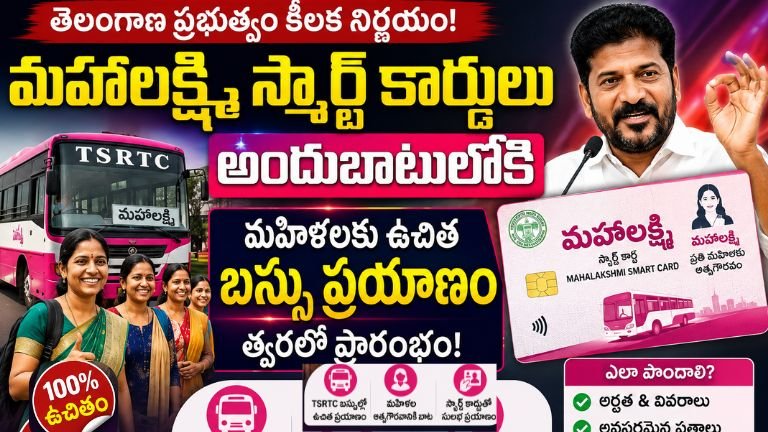
Telangana to Launch Mahalakshmi Smart Cards for Free Women’s Bus Travel
HYDERABAD: In a significant move to modernize public transportation and streamline welfare delivery, Telangana Chief Minister A. Revanth Reddy will officially launch the Mahalakshmi Smart Card initiative on June 2, coinciding with Telangana Formation Day. The introduction of these tech-enabled smart cards aims to digitize the Telangana State Road Transport Corporation (TGSRTC) services and simplify the ticketing process for millions of women commuters across the state.
Phased Rollout to Ensure Smooth Implementation
To mitigate potential technical glitches and address operational hurdles, the state government has planned a phased implementation strategy. The smart card system will initially debut as a pilot project across select jurisdictions, targeting one mandal per district. TGSRTC officials emphasized that a statewide expansion will only occur after the data collected during this pilot phase is thoroughly analyzed and any underlying technical issues are completely resolved.
Until the smart cards achieve a comprehensive, statewide rollout, the current verification system will remain fully functional. Women passengers can continue to access free travel benefits by presenting their physical government-issued identity documents to bus conductors. However, transport authorities have indicated that the smart card will eventually become the mandatory mode of verification once the infrastructure is fully established.
Addressing the Challenges of Manual Verification
The Mahalakshmi free bus travel scheme was originally launched on December 9, 2023, allowing women residing in Telangana to travel free of cost in regional transport buses. Under the initial framework, passengers were required to present physical identity cards to conductors for manual inspection during every single journey.
While highly successful in expanding transit access, the manual verification process introduced distinct operational challenges. Conductors frequently faced time constraints trying to scrutinize individual documents on crowded routes, leading to delays in ticket issuance and boarding bottlenecks. The transition to an automated smart card system is specifically engineered to eliminate these inefficiencies, accelerate boarding times, and establish a highly transparent data tracking mechanism.
Key Features of the Mahalakshmi Smart Card
The new transit cards integrate modern identification and secure scanning technologies. Each Mahalakshmi Smart Card will feature:
-
Embedded Microchip: For secure data storage and fast processing by onboard electronic ticketing machines (ETMs).
-
Visual Identification: The cardholder’s full name and a passport-sized photograph printed directly on the card face to prevent unauthorized transfer.
-
Quick Response (QR) Code: A secure QR code for rapid digital scanning.
-
Digital Integration: The card backend is digitally linked to the user’s secure government identification database, ensuring high data integrity and reducing identity fraud.
During transit, passengers will simply tap or scan their cards upon boarding. This instantly validates their eligibility, prompts the ETM to issue a zero-fare ticket, and allows conductors to manage passenger flows with minimal administrative delay.
Step-by-Step Application Process
The state government has established accessible avenues for eligible commuters to obtain their smart cards.
-
Where to Apply: Women can submit their applications in person at any local MeeSeva electronic citizen service center or at designated TGSRTC bus pass counters established at major transit hubs.
-
Required Documentation: Applicants must provide a valid government-issued identification card, a recent passport-sized photograph, and an active mobile number for verification and status updates.
-
Processing Fee: A nominal administrative fee of ₹50 is charged at the time of application to cover card manufacturing and chip integration costs.
Once the application is processed and background verification is completed via the linked databases, the personalized smart card will be issued to the applicant.
Expected Impact on Governance and Public Transit
The implementation of the smart card system is expected to yield substantial benefits for both the government and the public. For commuters—particularly those residing in rural areas—the system eliminates the logistical burden of carrying critical, original physical identity documents on daily commutes, reducing the risk of document loss or damage.
For TGSRTC and the state exchequer, the microchip and QR framework will provide precise, real-time data regarding passenger volume, peak travel times, and route utilization. This data-driven approach will significantly curb potential misuse of the free transit scheme, ensure accurate subsidy allocation, and allow transport authorities to optimize fleet deployment to better serve the public.
Because the Mahalakshmi Smart Card system is launching fresh as a pilot project, you cannot apply directly online through standard portals just yet. The state government requires applications to be processed in person via physical citizen service counters to link your biometric database profile.
To get your card now, you will need to follow the official offline submission procedure.
The Application Process
Important Note on Travel Security: While the pilot project rolls out across selected mandals, you do not need to worry about being denied free travel. The existing system remains active. You can continue to travel completely free of cost on eligible TGSRTC buses by showing your physical Aadhaar card or any other valid government photo ID to the conductor until the smart cards are standard statewide.